Your First Handgun: What to Know Before You Buy
What matters when buying your first handgun: caliber, size, action type, fit, and budget. A framework so you won't regret the decision.


Buying your first handgun is one of those decisions that can feel more overwhelming than it needs to be. Walk into a gun store without a framework and you will get opinions from everyone behind the counter. Everyone has their preferred brand and caliber. Browse online and you will find a hundred "best first handgun" listicles that all recommend the same three or four guns without explaining why.
This guide is not that. It covers what really matters when choosing your first handgun. By the end you will know what questions to ask, what to ignore, and how to make a decision that fits you best.
Start With One Question
Before you look at a single handgun, answer this honestly: What is the primary job this gun needs to do?
The three most common answers for a first-time buyer are home defense, concealed carry, and range shooting. Your answer to this question determines almost everything else.
A home defense gun does not need to be concealable. It needs to be reliable, easy to shoot accurately under stress, and hold enough rounds to be useful. Size and weight matter less because it doesn't live under your shirt.
A carry gun needs to be small and light enough that you will actually carry it every day. A gun that is too heavy, too bulky, or too uncomfortable gets left at home, which defeats the purpose entirely.
A range gun optimizes for comfort over long sessions, accuracy, and shootability. If you are buying primarily to shoot recreationally and develop skills, you have more flexibility on size and caliber. (ideally, you're at the range with your home defense and/or concealed carry gun, so this category doesn't matter as much unless you're entering the world of competition shooting.)
Most first-time buyers want one gun that does all three. That is a reasonable goal and the right framework will get you there.
Caliber: Why 9mm Is the Right Starting Point
Caliber debates have been going on since before most of us were born. For a first handgun in 2026, the answer is 9mm for the vast majority of buyers.
Here is the straightforward case for it.
Modern 9mm defensive ammunition has closed the performance gap with larger calibers like .40 S&W and .45 ACP. The FBI transitioned back to 9mm in 2015 after extensive ballistic testing, citing equivalent terminal performance with less recoil and higher magazine capacity. Law enforcement agencies across the country followed.
9mm produces less felt recoil than larger calibers, which means you can shoot more accurately (with regular training), recover between shots faster, and spend more time building skills instead of managing the gun. For a new shooter, this matters quite a bit.
9mm ammunition costs significantly less per round than .40 S&W or .45 ACP, which means more affordable practice. As covered in our bulk ammo buying guide, keeping your cost per round down is what makes consistent training sustainable.
9mm is available in more handgun platforms than any other centerfire pistol caliber, giving you the widest possible range of options.
The only reason to choose a different caliber for a first handgun is if you already shoot another caliber confidently, or if you have a specific application that warrants it. For everyone else, we recommend starting with 9mm.
Semi-Automatic vs. Revolver
Semi-automatic pistols use the energy from each fired round to eject the spent case and chamber the next one automatically. They hold more rounds than revolvers, reload faster with a magazine change, and have a trigger pull that feels the same on every shot once you learn it. The vast majority of modern defensive handguns are semi-automatics. They require more steps to operate safely and more mechanical understanding to maintain.
Revolvers are simpler to operate. You load the cylinder, point, and pull the trigger. There is no slide to rack, no magazine to seat, and no chamber to verify. The mechanical operation is visible and intuitive. The tradeoff is lower capacity (typically five or six rounds), a heavier trigger pull in double-action mode, and slower reloading. For someone who shoots infrequently and wants a reliable home defense option with minimal mechanical complexity, a revolver is worth considering.
For most first-time buyers who want a handgun for both carry and regular range use, a semi-automatic is the practical choice. The higher capacity, faster reloads, and consistent trigger pull give you more to work with as you develop skills.
Size: Bigger Is Easier to Learn On
We'll preface this by saying: Handle as many guns as you can. Everyone's hand sizes are different, as well as finger lengths and widths. If a Glock 19 feels good to me, that is no indication it will feel good to you.
Also, keep in mind: Smaller guns can be harder to shoot well, not easier.
A compact or subcompact pistol has a shorter barrel, a smaller grip, and snappier recoil than a full-size or mid-size gun. All of those things make learning the fundamentals harder. Short sight radius makes accurate aiming more difficult. A small grip gives you less to hold onto. More recoil means more muzzle flip to manage between shots.
Full-size and mid-size handguns are more comfortable to shoot, easier to shoot accurately, and more forgiving of technique errors. If concealed carry is eventually part of your plan, start with a mid-size platform. Learn the fundamentals well, build consistent habits, and transitioning to a smaller carry gun later is straightforward. The reverse is much harder.
Do not buy a subcompact pistol as your first gun because someone told you it was easier to carry. Buy something you can shoot well first. Carry comes after competence.
What to Look for When You Handle a Gun
No article can tell you what will fit your hand. That part requires actually holding the gun. Here is what to pay attention to when you do.
Grip fit. Your shooting hand should wrap around the grip naturally with your trigger finger resting alongside the frame, not stretched to reach the trigger. If your hand feels cramped or your trigger finger is straining, the gun is too large for your hand. Many modern handguns include interchangeable grip panels or backstraps to adjust fit.
Trigger reach. When you place your finger on the trigger, the pad of your fingertip should contact the trigger face. Too much finger on the trigger pulls shots left for right-handed shooters. Not enough pulls them right. Whatever you end up with, finger placement will become an important part of your training.
Controls. The magazine release, slide stop, and any manual safety should be reachable without shifting your grip. If you have to reposition your hand to operate the controls, that is a problem under stress.
Slide racking. You need to be able to rack the slide reliably every time. Some shooters, particularly those with less hand strength, find certain pistols difficult to rack. Try it in the store. Some manufacturers offer models with easier-racking slides specifically for this reason.
A Smith & Wesson M&P Shield EZ, and the Walther CCP are known to be easier to rack.
Action Types Explained
If you are new to handguns, you will encounter terminology around action types that can be confusing. Here is what it means in plain terms.
Striker-fired handguns use a spring-loaded firing pin instead of a traditional hammer. The trigger pull is consistent on every shot and generally lighter than double-action. Most modern defensive pistols are striker-fired. They are simple to operate, consistent, and require no manual cocking.
Double-action/single-action (DA/SA) handguns have a visible hammer. The first shot from a loaded chamber requires a long, heavy trigger pull that both cocks and releases the hammer. Subsequent shots use a shorter, lighter single-action pull because the slide cocks the hammer automatically with each shot. This inconsistency between the first and subsequent shots requires practice to manage well.
Single-action only (SAO) handguns require the hammer to be manually cocked before each shot or cocked by the slide cycling. The 1911 platform is the classic example. The trigger pull is excellent but the manual of arms is more complex. Not the right starting point for most first-time buyers.
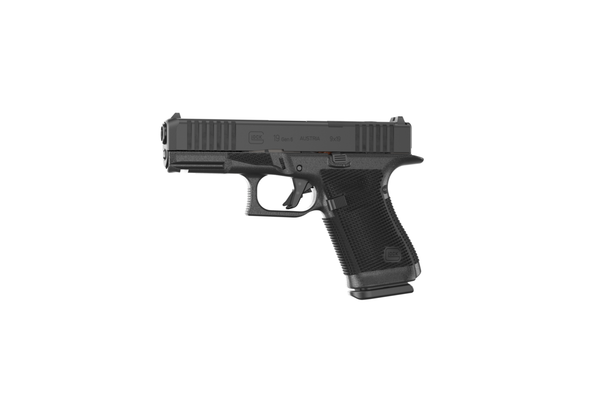
For a first handgun, striker-fired is the most practical choice for most people. The consistent trigger pull, simpler manual of arms, and wide platform availability make the learning curve manageable. Think Glock 19 here.
Budget: What to Expect to Spend
A reliable, capable first handgun costs between $400 and $650 in 2026. Every major manufacturer makes excellent defensive pistols in this range. Below $400 is possible with brands like Canik and Taurus, but requires more careful research into specific models.
Budget above $650 for a first handgun is rarely necessary. Performance gains above this price point are marginal for a new shooter who is still developing fundamentals.
Factor in these additional costs when you plan your budget:
A quality holster runs $40 to $100 for a kydex inside-the-waistband option from a reputable maker. Do not buy a cheap nylon holster.
A cleaning kit costs $20 to $40 and you will need it. The average gun owner falls short of cleaning and oiling their handgun routinely, but it should not be overlooked.
At minimum, budget for 500 rounds of practice ammunition before you consider yourself familiar with the gun. At current bulk pricing, that runs $95 to $125 for 9mm. See our bulk ammo buying guide for current pricing and where to buy.
A basic firearms safety course runs $100 to $200 and is worth every dollar. Many ranges offer them. Some states require one for a carry permit. If you go for your CPL (concealed pistol license), look for a reputable day class nearby. You'll be taught a lot of important legality, as well as get some range time.
Try Before You Buy
Most gun stores with an attached range will rent handguns for a small fee. Use this to your advantage. Rent two or three guns you are considering and shoot rounds through each. What felt comfortable in your hand at the counter may feel different after, say, 50 rounds. What felt awkward to hold may turn out to shoot beautifully.
If your local gun store does not have a range, go to the range first, rent a few guns, and then go to the store knowing what you want. We don't recommend buying blind.
A Note on Safety and Storage
Buying a handgun comes with real responsibility. Two things matter above everything else.
Training. Owning a handgun without training is like owning a car without knowing how to drive. Take a basic firearms safety course before or immediately after your first purchase. Learn the four fundamental rules of gun safety and treat them as non-negotiable. The USCCA and the National Shooting Sports Foundation both offer resources for new gun owners.
Storage. If there are children in your home, a quick-access pistol safe gives you fast access while preventing unauthorized use. A full-size safe is the right long-term solution. Ammunition stored separately from the firearm adds another layer of safety. There is no responsible gun ownership without responsible storage.
The Short Version
We do recommend 9mm, but the choice is ultimately up to you. Choose striker-fired unless you have a specific reason not to. Handle as many guns as you can before you buy. Spend money on training and ammunition. Store it safely.
The best first handgun is the one that fits your hand, fits your budget, and that you will actually train with. Everything else is details.
If you have further questions on this, please don't hesitate to reach out to us. We're here to help as many people become good stewards of gun ownership as possible.